A true story of how one adult forgot what Scouting stands for, and what it took to remind everyone that compassion, not control, is the mark of real leadership.
Scouts, October is Bullying Prevention Month, a time to remember that every scout deserves their place, no matter how different they seem or how much help they need.
This month is about recognizing and stopping bullying, wherever you see it. That includes bullying from anyone in power, whether it’s another scout or an adult leader. What follows is a fictionalized version of an actual bullying incident I encountered. Names and locations have been changed.
Crescent Lake: The Pacific Northwest: August
As a scoutmaster, I believe the real test of our character comes not when things are easy, but when we are uncomfortable and it’s easier to look the other way.
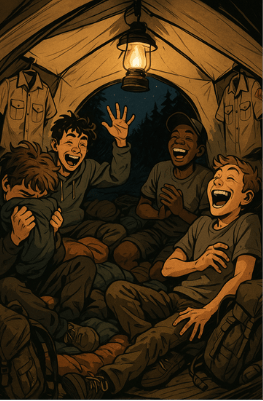
This past summer, our troop attended our annual week-long summer camp at Lake Crescent. The week is meant to be a highlight of a boys time in scouting. It’s packed with six days of earning merit badges, learning new skills and having fun, swimming, horseback riding, hiking, silly skits and songs every night by the fire. Most boys leave with great memories, new skills and hopefully new friends.
When I first stepped into the Scoutmaster role, I quickly learned this troop was extremely merit badge, rank and achievement focused. Scouts were expected to rank up at a rapid pace. Ninety percent of that expectation came from parents. That expectation extended into their participation at the annual summer camp. Scouts were expected to be in a merit badge class from first session (immediately after breakfast) through dinner. They were expected to spend their evenings on homework for the next day’s badges.
In my first year as Scoutmaster, and my first week long summer camp with these boys, I wasn’t interested in implementing and enforcing such strict schedules for the boys. If the boys wanted to keep their afternoons open to swim or canoe on the lake, I was fine with that. Unfortunately not every adult leader or parent felt the same.
On Wednesday afternoon, I returned to our base camp after helping a group of kids launch their kayaks on the lake. As I walked into our campsite, I heard a raised voice. It was and adult’s voice. And as I got closer, I realized something was wrong. That tone and volume of voice was inappropriate to use with a scout, no matter what the issue.
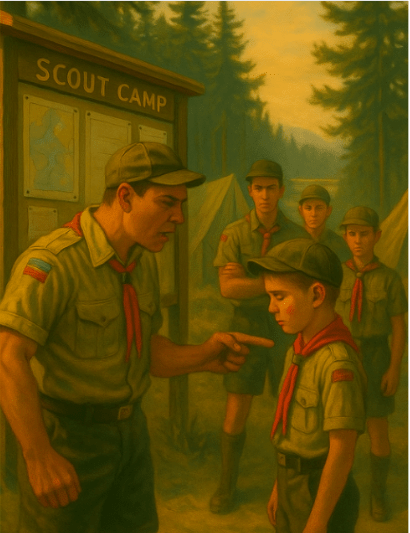
In the center of our base camp was a large bulletin board. On it, we listed all of the available merit badge classes and activities available that day. As I entered camp I saw an adult, a trained Assistant Scout Master, at the schedule board with a young scout. He wasn’t standing with the boy. He was standing over the boy, heavily berating him. His voice carried across the camp, sharp and angry.
“What’s wrong with you? Are you even trying? Why are you just wandering around doing nothing?”

The boy he was yelling at was Michael. Michael was new to scouting and our troop. He had only been a member of our troop for two weeks. I have a hunch Michael’s mom put him in scouts for a two reasons; to teach him how to socialize with other kids his age and, mainly, to get him out of her house for a week. Parents dumping scouts into extended summer camps happens more often than we admit. (More on that in next week’s post.)
In addition, it was clear Michael had some special needs. But being with the troop only two weeks and new to scouting, he was clearly lost and overwhelmed. He clearly had social issues. He clearly had high anxiety. We was clearly on the spectrum.
Prior to camp I met with his mother and helped her sign Michael up for several merit badge classes; environmental science, first aid, swimming lessons and, arts and crafts. For the first day of camp, Monday, Michael went to each session and followed his schedule. He was off to a good start. But something happened and Michael stopped going to his classes on Tuesday and Wednesday. I don’t exactly know why. But my guess is that Michael has never been used to structure and never independent enough for a week long program like this. He spent Tuesday and Wednesday simply walking from place to place around the entire camp, not completing any work. This was discovered when an Assistant Scoutmaster checked all of the boys attendance records. This adult leader called him out in front of the entire camp, marched him to the center board and started berating him. Every scout and adult saw the incident. I was especially let down when I saw that no other adult leader stepped in to stop the situation.
“You’re wasting everyone’s time!” The adult leader yelled at him again.
This adult had chosen to humiliate him in front of everyone.
Michael wasn’t lazy. Michael wasn’t stupid. He was lost. The difference is important.
As I got closer, I saw Michael was crying. Loud uncontrollable sobs. He was sitting on the ground knees curled to his head, rocking back and forth. The adult leader saw this as weakness. So he doubled down.
“What’s your problem? Can’t you follow simple directions?”
Michael stayed curled in a ball, tears streaming down his face, unable to process what was happening or how to make it stop.
I stepped in, standing between Michael and the adult. I told the adult, firmly but calmly trying to contain my temper, that this was not how we treat anyone, especially a kid who is struggling. I told him to step away and take a moment to cool off. To my surprise, the adult leader pushed back. He had no idea what he was doing was wrong.
I don’t usually raise my voice. I just said, “Hey, that’s enough.” He didn’t like that.
The man turned to me, annoyed. “I’m correcting his lazy behavior,” he said. He said the boy needed discipline, that “the troop’s gone soft.” That kids like this are the reason the troop is falling apart.
“Bullshit,” I snapped back at him. And bullshit was right. The adult leader wasn’t correcting lazy behavior. He was using his role as an adult and his power as an adult to humiliate a member of the troop with no power. That’s bullying. The adult was doing this in full view of the entire troop of boys. And he did that on purpose. It was a control tactic. If the other boys saw his anger and saw his power, they will do what he demands, just to avoid the same humiliation. Again, that’s not leadership or mentoring. It bullying. Using power to intimidate future behavior.
The adult leader was wrong. The troop wasn’t going soft. Michael wasn’t making the troop weak. The problem was with the adult leader. He didn’t understand that his power as an adult comes with responsibility…and empathy. He practiced cruelty on a weaker person while hiding behind the justification of discipline and tough love. The adult leader was the one making the troop weaker.
I turned to Michael.
“You’re OK,” I told him quietly. “You’re not in trouble. We just need to help you more.” He nodded and slowly calmed down. I sent him off to the restroom with the Senior Patrol Leader to wash his face and get a drink of water.
Then I stood back up and looked at the man.
“I can’t use you here anymore. We will not treat kids that way. If that’s too much for you, then thank you for your time. If you think that’s making the troop weak, then so be it.”
He stormed off. Fine by me.
Our job as adults is to lift kids up, not tear them down. If a scout is struggling, it’s our responsibility to offer guidance and patience, not shame and blame.
That night, I called the troop together. We talked about what had happened, not to single out anyone, but to make sure everyone understood what our troop now stands for. I told them about the idea that everyone is welcome, and about the importance of sticking up for the underdog. I asked them to look out for each other, especially those who seem lost or alone.
Bullying can happen anywhere, even from those who should know better. As leaders, we can’t just hope it goes away, we have to confront it head-on. We have to model compassion, inclusion, and courage, not just for the scouts, but for the adults too.

The week reminded me that the heart of scouting isn’t in the badges or the skills, but in the way we treat each other. Michael went home earning zero merit badges that week. And I was fine with that. It was the first time he ever rode in a canoe. It was the first time he ever sat around a campfire singing silly songs with kids his age. It was the first time he ever touched a horse. But he did go home knowing that someone saw him, stood up for him, and believed he belonged.
That’s the lesson I hope every scout, and every adult, takes home from camp and into their daily life.
#
October is Bullying Prevention Month, a time when we remind ourselves that every scout deserves a place in the troop and life, no matter how different they seem or how much help they need.