Before Arnav Patel became a Scout, a leader, and a hero, he was a thirteen-year-old captain with a cricket bat, a best friend, and a one-way ticket to Seattle. This is where his story begins.
Meet the Kids Who Will Change Everything: Origin Stories from the Young Adult Novel The Great American Eagle Hunt
Before there was a team, there were five kids with five very different stories. Over the next several weeks, we’re telling them, one by one. Meet with Arnav Patel.
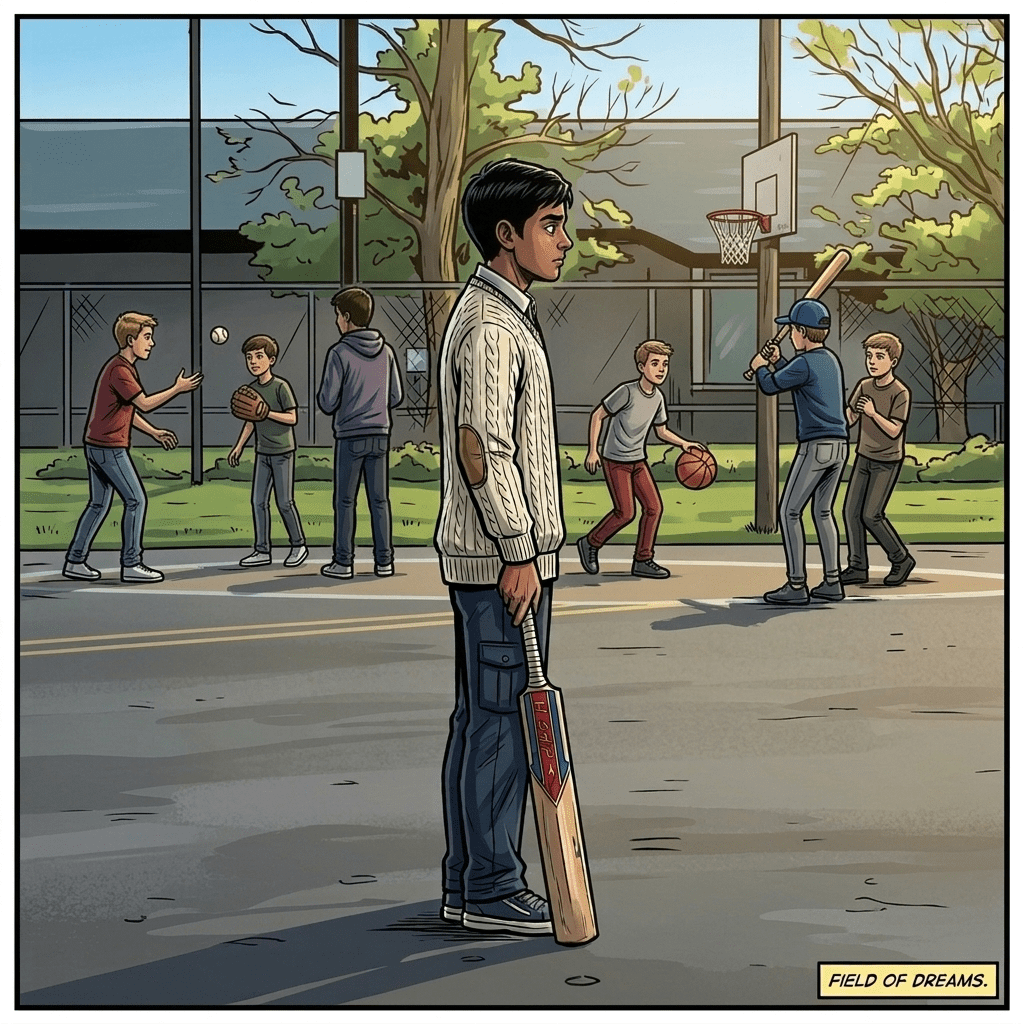
Bangalore, India: St. Xavier’s Middle School Cricket Ground:
late December 1998, Friday Afternoon
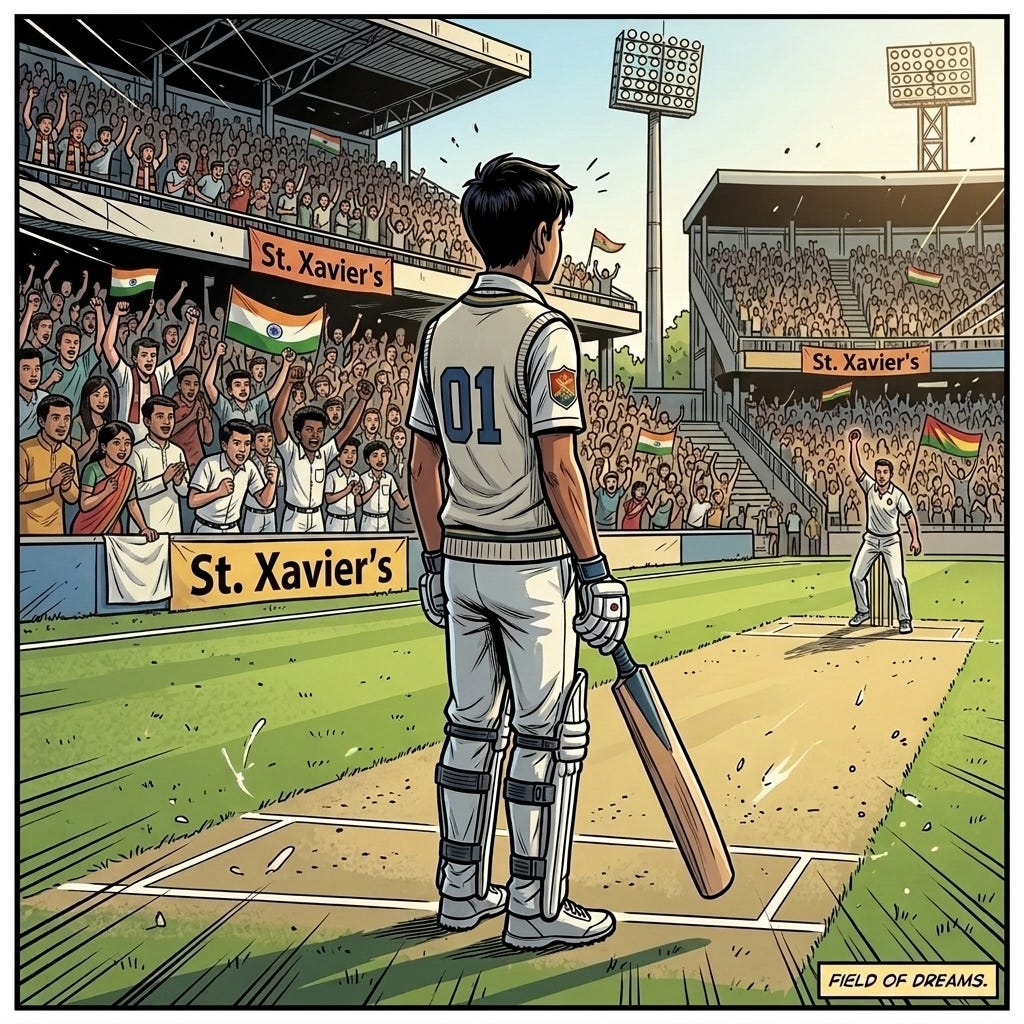
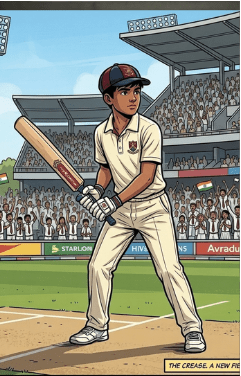
The late afternoon sun beats down on the lush green Cricket pitch behind St. Xavier’s Middle School. The air shimmers with the afternoon heat. But the heat doesn’t bother any of the players or spectators. Today it’s a competitive tension that fills the air. Parents fill the far ends of the bleachers, part in the shade, part exposed to the sun. The center section is crammed with students in their crisp white school uniforms.
A sign flaps in the slight breeze as it hangs from the top of the pavilion: Bangalore District Middle School Cricket Championship Finals—St. Xavier’s versus Bishop Cotton. This is a cross-city rivalry going back years. A rivalry active longer than many of these 13-year-old boys have been playing the sport.
Tradition and pride are key in today’s match up. Cricket is often called ‘The Sport of Kings,’ ‘The Gentleman’s Game,’ ‘The Long Game,’ or ‘Chess on Grass.’” These names fit, thanks to the game’s complexity, deep strategy, marathon matches, and popularity among aristocracy.
Today at the edge of the field, thirteen-year-old Arnav Patel stands with his team, watching, analyzing, studying every player and every move on the pitch. His eyes move across the pitch in steady sweeps, tracking the position of every Bishop Cotton fielder, reading the slight forward lean of their wicket keeper, the tension in the bowler’s shoulder. He calls out to two teammates on the field.
“Yuvaan, you’re faster than their fielders. Push singles, make them chase. Ravi, you wait for the short ball, that’s your strength.”
Now Arnav knows he has his teammates set up to score the winning runs.
He knows his time is coming. He closes his eyes, takes a deep breath, and clears his mind.
“I’ve got this,” he says to himself.

Arnav opens his eyes, scans the pitch one more time, and walks to the crease. His bat taps the ground with each step, a superstition he’s kept since the age of seven. This is his grandfather’s cricket bat, worn smooth by three generations of Patel batsmen. His teammates recognize his tradition of tapping the bat as he walks. They know it’s his sign of confidence.
“You can do this, Arnav!” His teammate and best friend Rohan calls from the side bench.
“Show them, Captain!” another voice calls from the pavilion.
Captain. The word still feels new to Arnav. He was elected at the start of the season. His teammates elected him even though they know he will leave them at the end of the season. He will not continue with this team to the upper-level leagues. Still, it’s a message from his teammates that this is his team for life. No matter where life takes them. They elected him not because he is the loudest, most athletic, or most aggressive. They elected him because he knows them all, each individual strength and weakness, when to attack, when to defend. When the pressure is on, Arnav, the quiet one, stays the calmest.
The audience sees Arnav approaching the crease. They quite down and lean in focusing all their attention on this one boy.
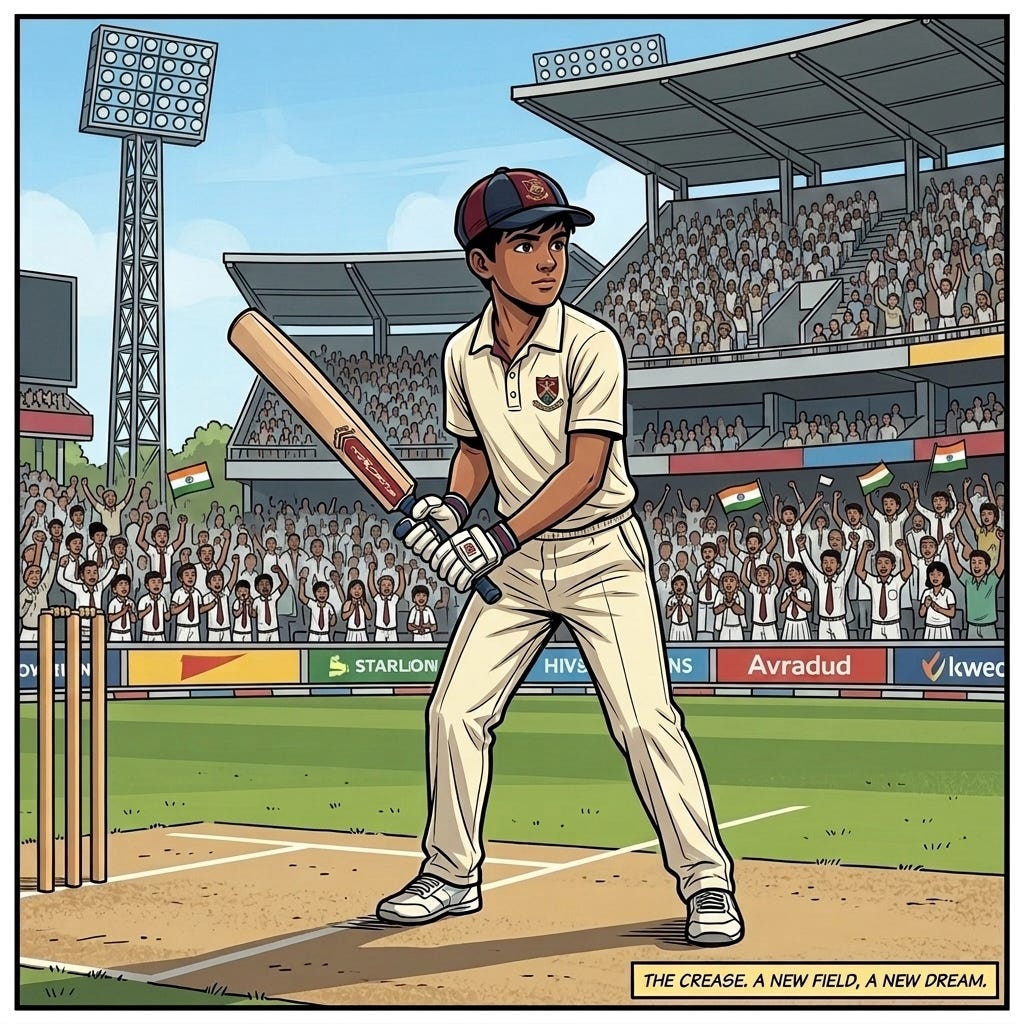
The bowler, a tall kid named Vikram who’s already being scouted by the state youth team, stares at him from the other end of the pitch. Arnav knows Vikram well. They’ve been playing against each other on various teams since age seven. Arnav knows every stance, grip, alignment and release Vikram can throw at him. And Vikram knows the same about Arnav. Vikram has been studying every cut, pull, and sweep Arnav can execute. This is a meeting of the league’s best.
Arnav takes his stance, bat raised, eyes on the bowler. Arnav gives Vikram a smile, as if to say, “I know something you don’t.” Vikram doesn’t let Arnav get in his head. Vikram simply looks at his competitive friend and returns the smile as if to say “So do I.”
Arnav hears his father’s voice in his head.
“It’s not about hitting every ball. Patience brings rewards. Wait and look for what you want. Just like life.”
First ball: Fast, outside. Arnav lets it go. The wicket keeper catches it with a loud smack.
“Good leave!” His batting partner, Suresh, calls from the other end.
Second ball: Short, rising toward his ribs. Arnav rocks back, hits and pulls it hard. The ball races to the open grass by the boundary. Four runs are scored!
The St. Xavier’s section erupts with yells of “YES! ARNAV! WELL PLAYED!”
Vikram’s next deliveries are faster and less controlled. The next ball is a full toss. Arnav’s eyes light up.
“I’ve got this,” he says to himself.
He steps forward and drives it straight down the line. The fielder in the far-out field can only watch as it sails over the rope.
The crowd goes wild as St. Xavier’s wins.
Chaos erupts in the stands. Students pour onto the field. Arnav’s teammates mob him, lifting him onto their shoulders. He raises his bat high, like a trophy. Parents cheer, whistle, and take photos.
“ARNAV! ARNAV! ARNAV!”
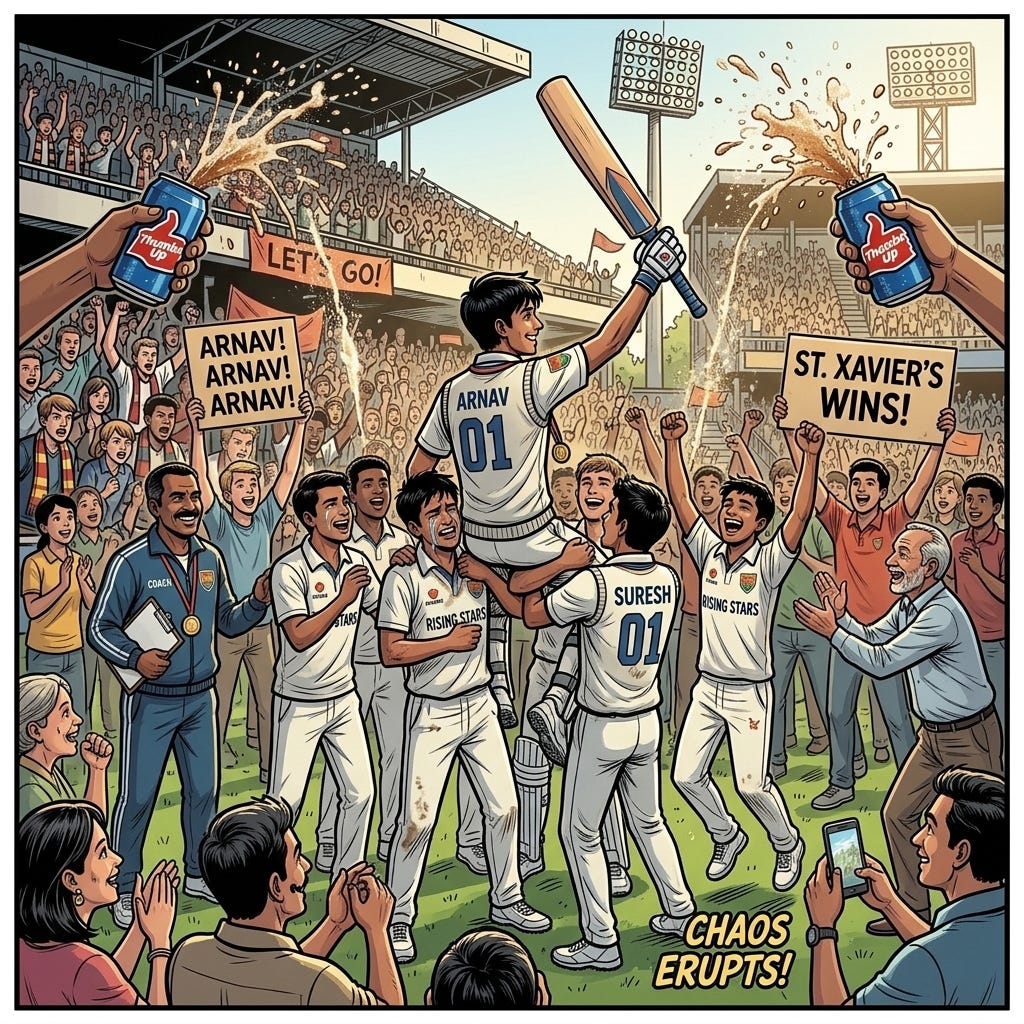
They carry him to the sidelines, celebrating their captain. Rohan is crying with happy tears. Suresh is jumping up and down with uncontrolled joy. Even their stern coach, Mr. Krishnan, is grinning from ear to ear. His father rushes onto the field. He is clapping so hard, his hands hurt. He grabs Arnav in a big bear hug.
A few minutes later, the trophy ceremony becomes a blur of speeches and celebrations. Arnav accepts the winner’s cup on behalf of his team, giving a short speech thanking his team, the coaches, and his competitors. His teammates douse him and all innocent bystanders with an explosive fountain spray of THUMBS UP, their favorite fizzy carbonated drink. Everyone is laughing, planning the victory party, already talking about the next season. Arnav catches his father’s eye. His father gives him a nod. Arnav knows his father is proud of him.
At that moment, Vikram, the pitcher from the opposing team, shoulders his way through the crowd standing toe to toe with Arnav. They stare at each other face to face.
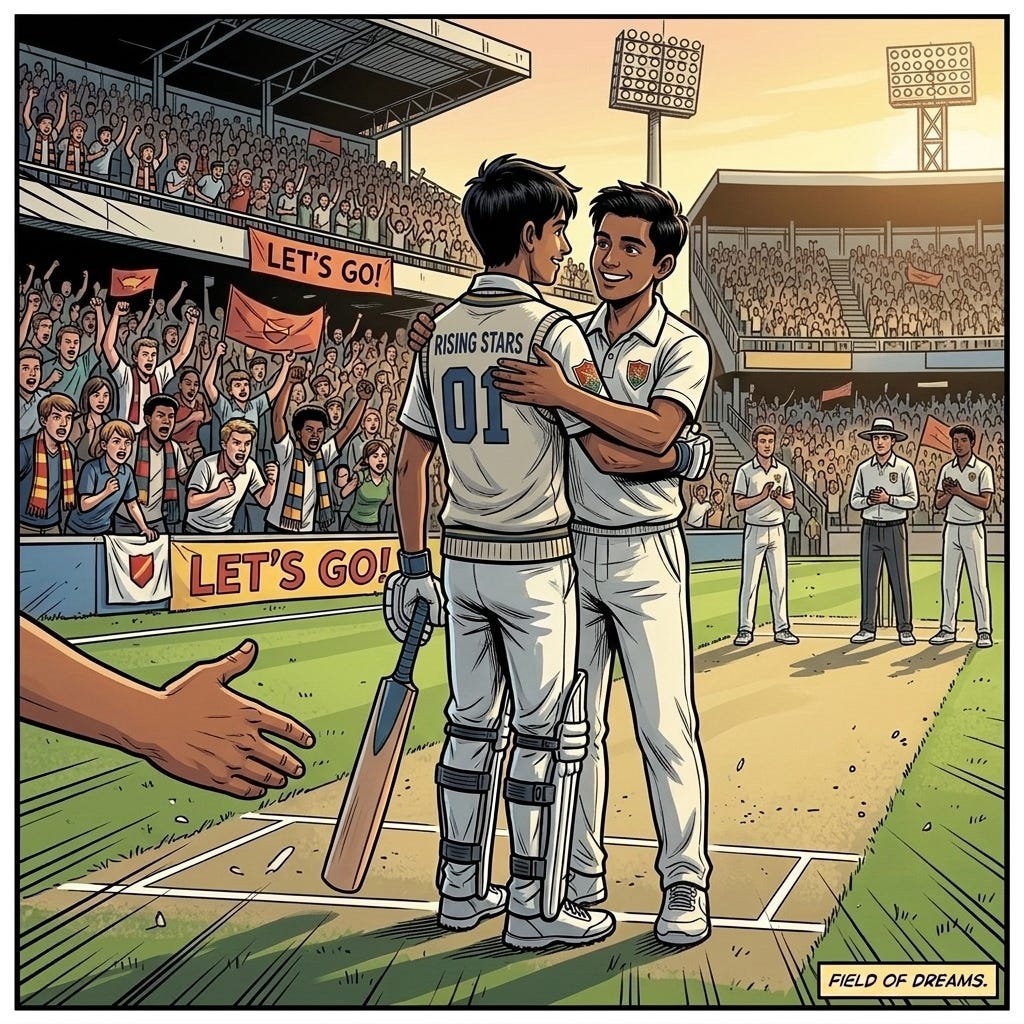
“Congratulations,” Vikram extends his hand. “We’ve always been competitors. But I will always think of you as my friend.”
The boys shake hands and give each other a friendly hug. Even though they have been competitors for most of their lives, their mutual love of the game has taught them the lesson of mutual respect, making them good friends.
An hour later, after the ceremony, most of the crowd has dispersed, Arnav sits on the pavilion steps with his best friend Rohan. They watch the city lights flicker alive during the blue hour, the time after sunset when the sky is a striking indigo blue. The day is closing.
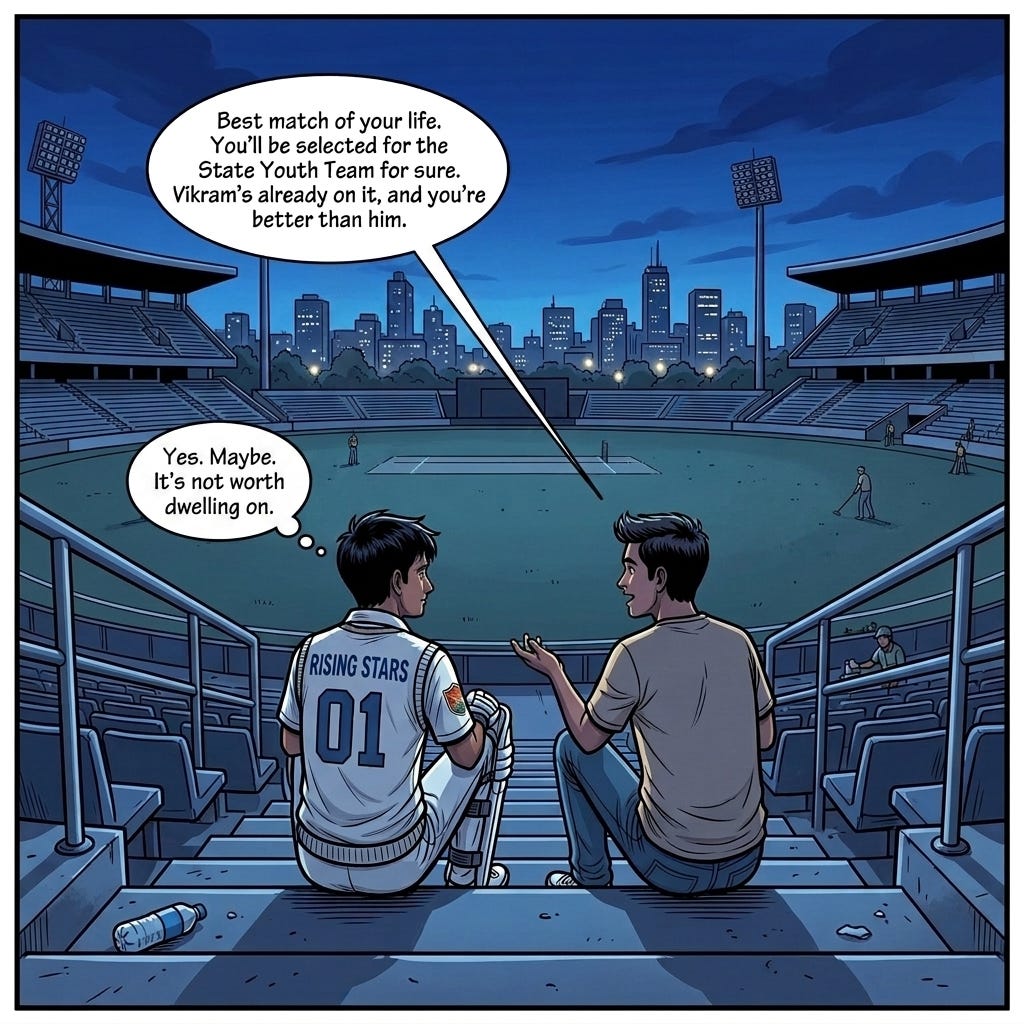
“Best match of your life,” Rohan says. “You’ll be selected for the State Youth Team for sure. Vikram’s already on it, and you’re better than him.”
“Yes. Maybe. It’s not worth dwelling on.”
“‘Maybe? Are you kidding? You just hit the winning runs in the district championship! You’re a legend! They’ll probably name the cricket pavilion after you!” Rohan says.
Arnav forces a laugh at Rohan’s exaggerations.
“The State Youth Team will be an honor. But I’ll be gone by then. It’s not worth talking about.” Arnav says, trying to shut the conversation down.
“Yes. I know. But I don’t like to remember. I can’t imagine myself ever leaving our beautiful India,” Rohan says.
“I never expected it. But my father’s office at Microsoft offered him a good position in their main office in Seattle. It’s a very good move for him. But we’ll be back here often to visit. This will not be goodbye forever.”
The boys sit in silence in the bleachers staring across the green grass of the cricket pitch. Beyond the pitch they can see the tops of the turrets of Bengaluru Palace jutting above the treetops.
“America,” Rohan sighs. “The other side of the world. Everything will be different.” Rohan turns to his friend. “I will miss you, Arnav. But I hope you have a fantastic adventure.”
“I’ll miss you too,” Arnav says, putting his arm around his friend. “Let’s go. I’ll treat you to some Jalebi.”
“That sounds good.” Rohan says.
“Promise me something, Arnav,” Rohan says as they get up from the bleachers. “Promise me that when you reach Seattle, you won’t make yourself small. Be the best Cricket player Seattle has ever seen!”
“First I have to find a Cricket team in Seattle,” Arnav laughs.
“You’ll find your team there. I am positive about that. I know that soon, they will elect you as their captain. Your name means an intelligent and wise person. Remember that. Make the change you want to see.”
“I promise, macha. I will tell them all about this beautiful place.”
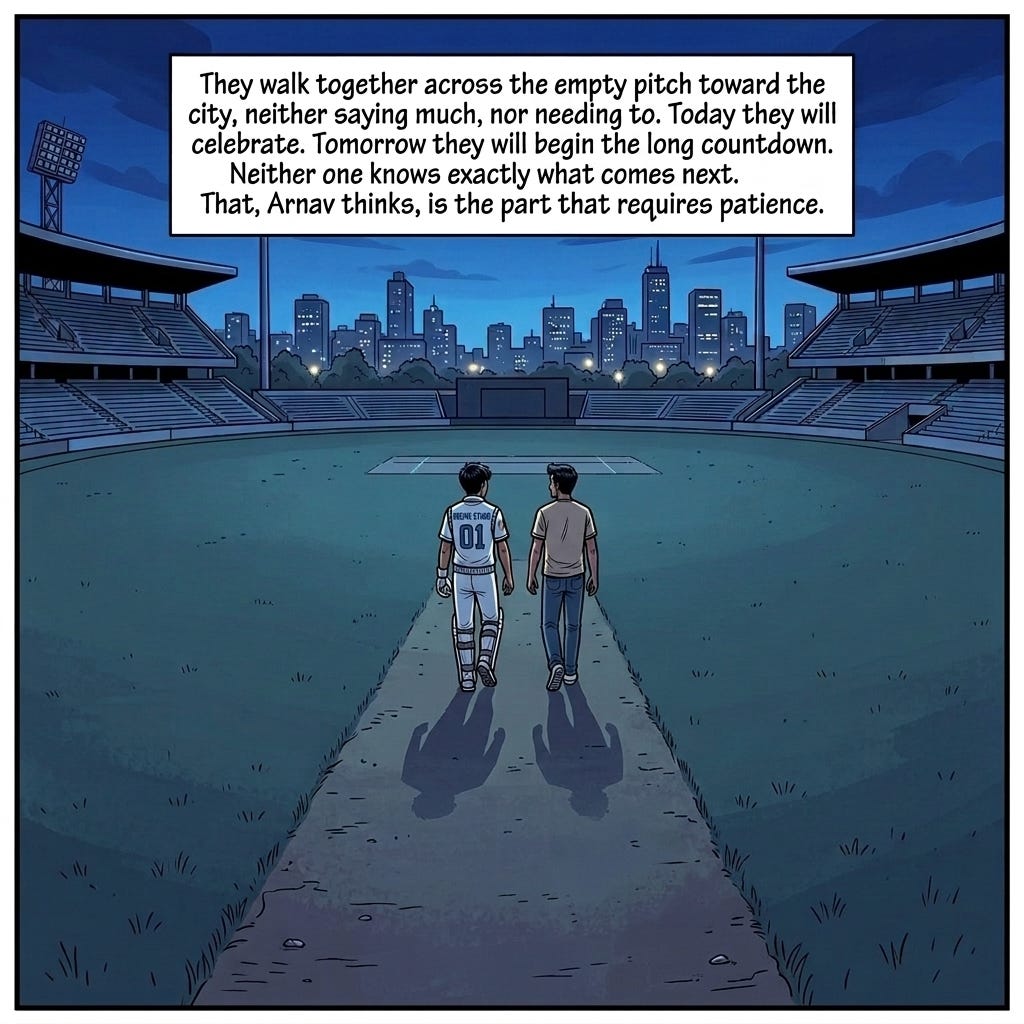
They walk together across the empty pitch toward the city, neither saying much, nor needing to. Today they will celebrate. Tomorrow they will begin the long countdown. Neither one knows exactly what comes next.
That, Arnav thinks, is the part that requires patience.
You’re Reading: The Road to the Eagle Hunt: Origin Stories from The Great American Eagle Hunt. Arnav didn’t know it yet, but the team he was looking for was already being built.
While he was finding his footing in Seattle, other kids across the country were going through their own defining moments. Each of them would eventually find their way to the same troop, the same challenge, and the same impossible mission.
This is a five-part origin story series. Each installment stands alone, but together they tell you everything you need to know about the young man part of The Great American Eagle Hunt, before the adventure even begins.
Part 1 — The Last Game He Would Ever Play for India
Part 2 — Nobody Told Him That Fitting In Would Cost Him Everything
Part 3 — The Bald Kid on the Sticker-Covered Bike Changed Everything
Part 4 — They Gave Him Bad Rope, a Torn Tarp, and Rigged the Game. He Won Anyway.
Part 5 — One by One, His Friends Quit. Then He Did Too.
More origin stories are here. Over the coming weeks and months, meet the other young men whose paths are about to collide, each one carrying a story that shaped who they became when it mattered most.
The Great American Eagle Hunt, the novel these characters call home, is available soon.
If this story moved you, share it with someone who may enjoy it. Forward this post. Send the link. Tag a Scout, a parent, a teacher, or anyone who still believes the right story finds you at the right time.— Joe Paul, Author