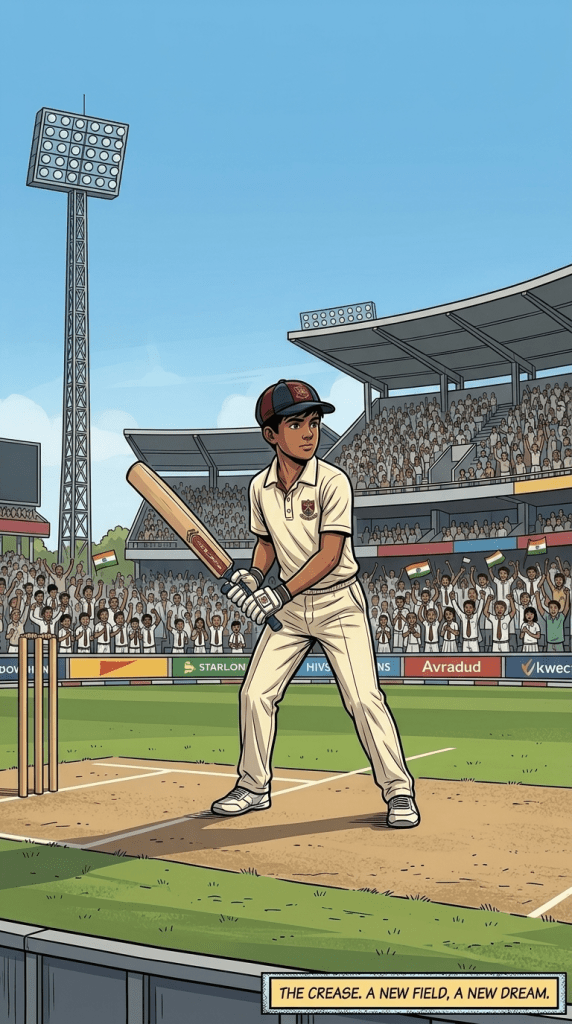
Nobody Told Him That Fitting In Would Cost Him Everything
Meet the Kids Who Will Change Everything: Origin Stories from the Young Adult Novel The Great American Eagle Hunt. Before there was a team, there were five kids with five very different stories. Over the next several weeks, we’re telling them, one by one. Meet with Arnav Patel.
#
Seattle, Washington, 14th Avenue, West Queen Anne neighborhood. Early April 1999, Monday morning, 8:30 am.

Arnav stands alone in his new bedroom, 8,000 miles from the one he left behind.
A few moving boxes remain stacked in the corner, still unpacked. He has been here for two weeks. His father arrived in January to start the new job at Microsoft, find a house, and prepare for his family’s arrival. Arnav, his mother, and his sister Anjali flew over in late March when the school year in India ended. His father’s plan is straightforward: enroll the children in American school now, before the American school year finishes in late May. If Arnav already knows some students by September, the transition into high school will be easier. Arnav understands the logic. He agrees with it. But that does not make standing here any less strange.
As Arnav looks out his bedroom window, he spots the morning ferries shuttling across Elliot Bay. He has no idea where these ferries and other ships on the bay are headed. But they fascinate him.

“I must remind myself; I am on an adventure. I’ve come this far. I must embrace this adventure, not resist it,” he thinks to himself. “Today I begin the search for my new team.”
“Arnav, we are leaving in 20 minutes. Please be ready,” his mother yells up the stairs.
“I’ll be ready, thank you,” he yells back.
Arnav looks in his closet one more time.
“What do I wear?” He asks himself. In India, the answer was simple. He would wear his school uniform; a white cotton button down shirt with the school emblem sewn on the shirt’s pocket, blue tie, white pants. Here in Seattle, his new school does not have a uniform requirement. For Arnav, that brings freedom and confusion. His mind races from excitement to confusion over and over again.
“I can wear anything I want? Great!” He pauses “But what do I wear? My traditional Kurta? Or do I need to dress more American? What does dressing American even mean? I want to fit in, but do I need to dress like everyone else?”
He decides to play it safe, choosing a pair of blue linen pants, a white linen button-down shirt, and white tennis shoes to finish the look. After throwing on his clothes, he takes one last look in the mirror. Shirt pressed and tucked in. Hair combed. Shoes tied. This should make a good first impression.
Arnav crosses his room to his desk and opens the slim top drawer. He picks up the letter his best friend, Rohan, gave him on the day Arnav left India. Arnav opens it and reads it to himself one more time. He needs a boost of courage.
“Captain,
America is lucky to have you. Show them how we play in Bangalore. Show them what real friendship looks like. Don’t forget us. We won’t forget you. You’ll always be our captain. Visit us soon. – Your team.”
He reads it once, sighs, folds it carefully, and puts it back in his desk drawer.
“I’ve got this,” he tells himself.
He turns towards his bedroom door, picking his backpack up from his bed. Before he leaves, he reaches down beside his dresser, where his cricket bat leans. He picks up the bat and starts walking down the hall, tapping the ground with each step.
Seattle, Washington, 10th Avenue Middle School, April 1999, Monday morning 9:00am.
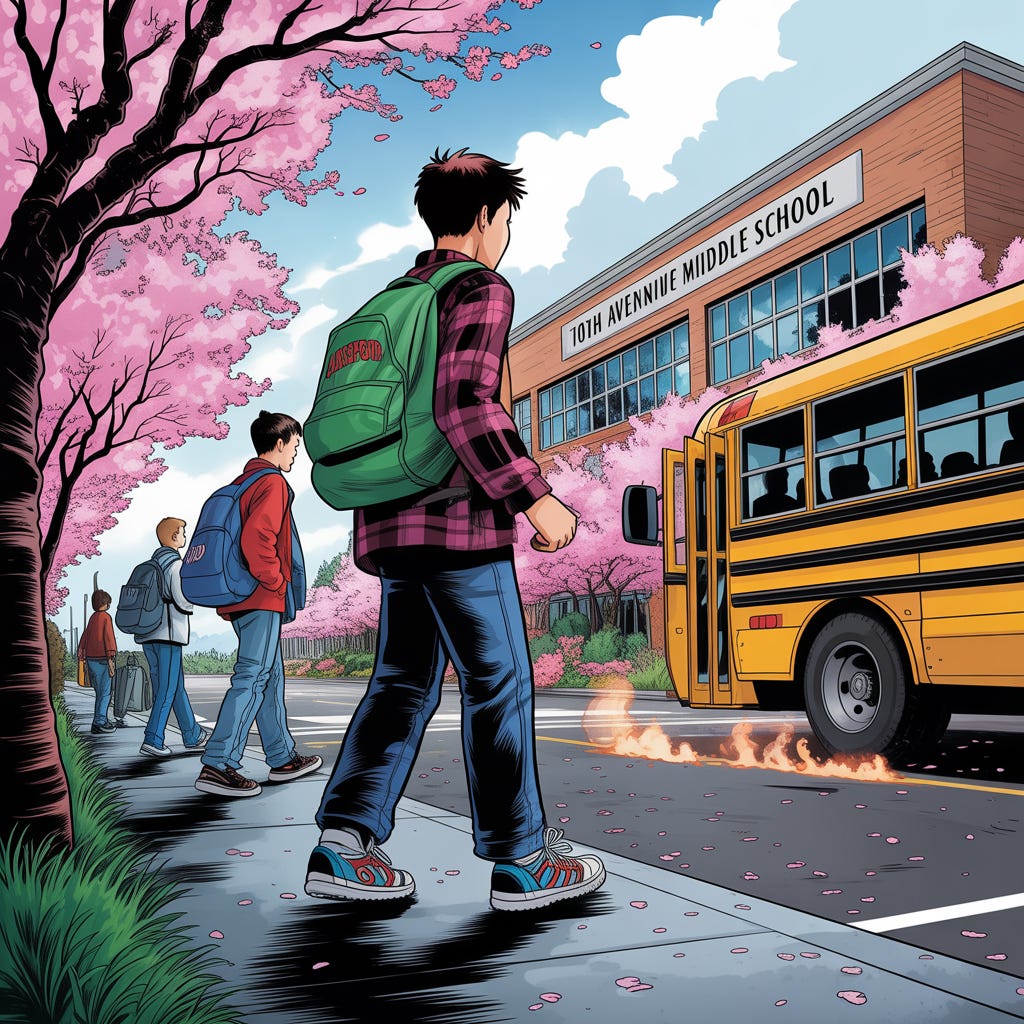
The morning bell rings and Mrs. Kittle’s 8th grade class is still a beehive of chaos. Even though spring break is officially over, the kids are not ready to get back to work. Conversations about camping trips, baseball games, and the newest Pokémon game still dominate the room.
“Settle down class.” Mrs. Kittle slowly calms the room down. “In your seats. We have a special start today.”
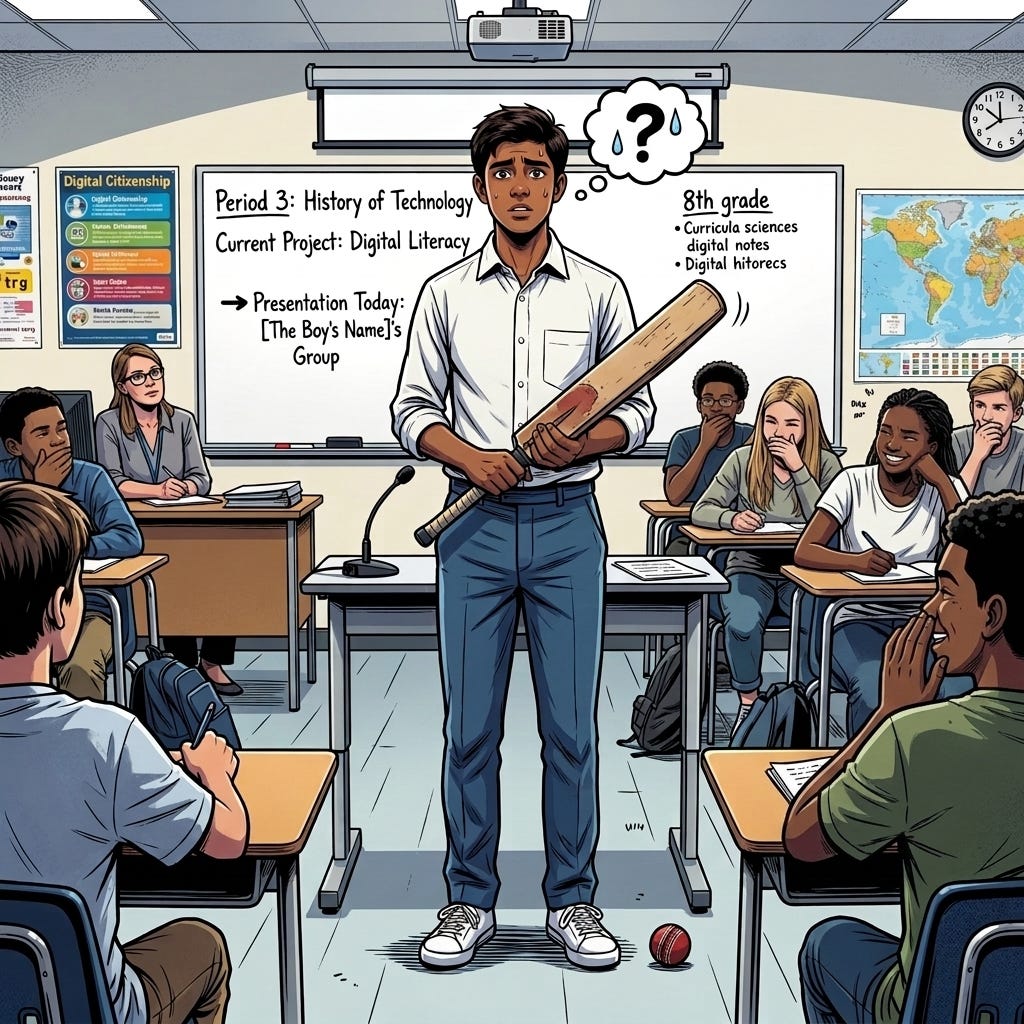
As the class quiets, Arnav remains frozen at the front; he hasn’t been assigned a seat yet. He stands at the front of the room with his cricket bat in both hands while the teacher settles everyone down. He scans the classroom the way he scans a field: looking for openings, opportunities for new friends and danger zones. Twenty-three students stare back at him. None of them look at him the way his teammates used to; as trusted friends, as their Captain. They are looking at him as odd, an outlier, the new kid. Arnav knows he hasn’t earned their trust yet.
“Where do I go? What do I do?” He asks himself.
“Arnav, please join me in front of the room,” Mrs. Kittle summons Arnav to where she is standing.
“Class, today we are going to start with an introduction. We have a new class member. Please welcome Arnav Patel. Arnav and his family have moved here from Bangalore India. Please make him feel welcome.”
The class breaks into a polite round of applause.
“During the break, I’ve met with Arnav’s parents and reviewed his academic records. He will fit in with us perfectly. Did you know in India the school year typically ends in March? Therefore, he is nearly complete with his studies and may be a bit more advanced in some of our work. But in some subjects, like American History he will be behind. So, let’s all help him when we can. To break the ice, I’ve asked Arnav to bring something to class today from his home. Something that is important to him. Something that will tell us a little bit about him. Arnav, did you bring something today?”
“Yes, ma’am,” Arnav replies. Arnav holds up his cricket bat. Arnav notices a few students snickering quietly.
“Do they not call their teachers Ma’am and Sir here in the United States?” He asks himself.
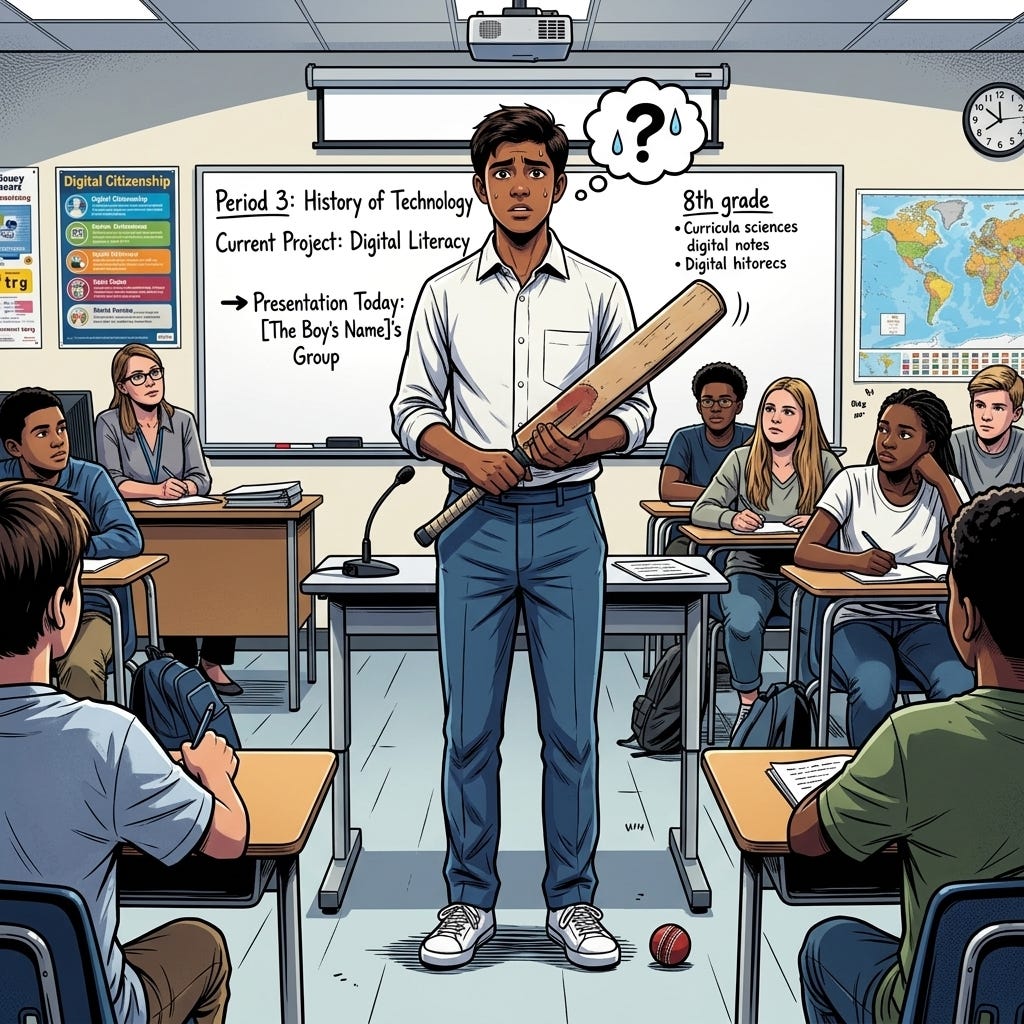
“This is my cricket bat. In India, Cricket is a very popular sport. At my middle school I was captain of our school team. This year we won the Bangalore Middle School Championship. It was a very big rivalry and an honor to win. If you would like to learn how to play, I would be very happy to teach you.”
Arnav looks hopefully across the class. Is anybody interested? He waits hopefully for someone to raise their hand. He hopes to hear from someone… anyone. But the raised hand never comes.
Suddenly a hand rises from a boy in the back row.
“Can you repeat that?” The boy asks. Others in the class stifle snickers and laughs.
“My accent. They are laughing at my accent,” Arnav realizes.
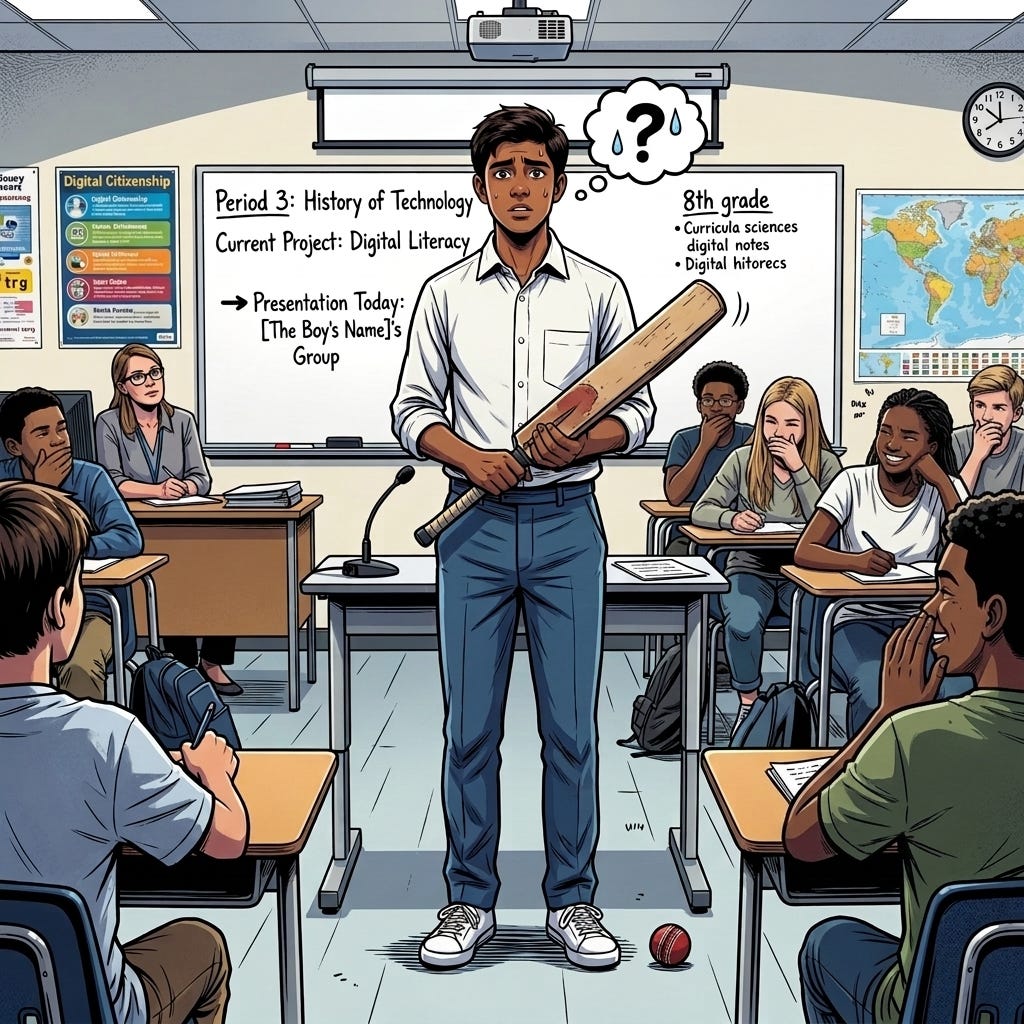
“You’re doing fine,” Mrs. Kittle encourages him. Arnav continues.
“Also, when I am not playing Cricket, I am a member of the Bharat Scouts and Guides. It is very similar to The Boy Scouts of America here. As a Bharat Scout, I am at the rank of Tritiya Sopan Scout. That is the third rank a boy can earn. This rank focuses on leadership, planning, teaching, and service to others.”
“Thank you, Arnav. That was very informative,” Mrs. Kittle says. “I have a desk set up for you in this second row. We’re excited you are here with us.”
Arnav finds his assigned desk, sits down, and begins to unpack his backpack. The morning progresses through math and social studies. With each hour Arnav feels eyes on him. He catches stares of curiosity as he turns and looks at his fellow classmates. Arnav understands that this is part of fitting in. He thinks back to his days on the Cricket team back home in India. The newest member of the team was always stared at, studied and not fully trusted. Today, he is that new team member.
Lunch period came at 12:00 sharp. The class is dismissed and sent to the cafeteria. The hallway is filled with all the kids in the three eighth grade classes who eat lunch at the same time. But Arnav finds himself alone. He stands at the cafeteria entrance with his home packed lunch in hand, scanning the room. The lunch period has just begun, and the room is already in chaos, chairs scraping, trays clattering, ninety voices bouncing off cinder block walls.
The cafeteria is organized like a military mess hall with rectangle tables arranged in long rows. Kids at the tables are clustered into friend groups. He quickly realizes he doesn’t belong to any of them. Athletes in the center table, next table over, a group of kids playing a Pokémon card game, next table over a group of girls leaning over the table looking at a fashion magazine. None of them look up. None of them have an open seat for a person they don’t know.
“Where do I go? Do I just sit down somewhere and introduce myself? Do I just act like I belong there? Or do I need to be invited? Everything is different here. I miss my team.” Arnav eventually chooses an empty seat at the end of a table near the windows.
Arnav looks around and notices none of the other students has a steel tiffin, a three-tiered round lunch box made of stainless steel, like he does. Everyone is either buying food from the lunch line or having a brown paper bag from home with a sandwich inside. The three-tiered container sits in front of him and sticks out like a monument to his difference.
A smile grows across his face as he realizes what his mother packed for him this morning; each compartment containing something different; rice at the bottom, Sambar in the middle, a thin, tangy lentil and vegetable stew with carrots and potato chunks; Arnav likes when his mother makes the Sambar and leaves the vegetables in large chunks. And in the smallest compartment at the top, a spoonful of mango pickle relish.
The smell rises up the moment he opens the lid. He smells the citrus like Tamarind, the savory Hing spice like garlic, the herbal curry leaves, cumin and mustard seeds. The spicy aromas remind him of being home during the rainy season. This is the perfect comfort food.
At that moment, Arnav feels the vibe in his corner of the room to change. Suddenly, everything is quieter. He catches the glimpses of other kids turning their heads to stare at him. A girl across the table and maybe ten feet away from him, leans toward her friend and whispers something. The friend wrinkles her nose.
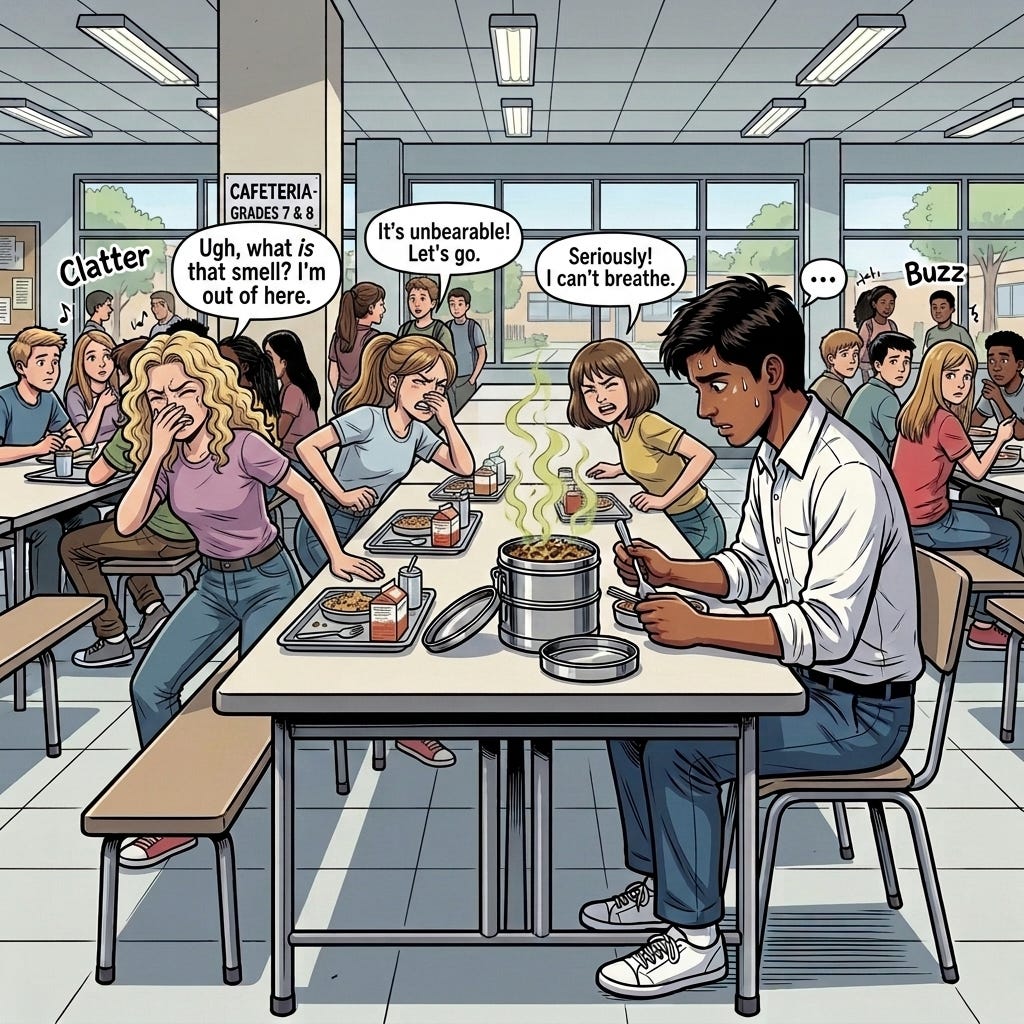
“What is that smell?” He overhears her asking. They glance toward Arnav’s tiffin, then quickly look away. Within thirty seconds, they pick up their trays and move to a different table.
Arnav pretends not to notice. He closes the lid to his favorite dish. “Am I really being avoided because of my lunch?” He asks himself. Feeling ashamed, he doesn’t look up from his table. He eats the first piece of Naan staring down, not making any eye contact.
“Maybe I should just get in line with everyone else,” he thinks. “Buy whatever they’re selling. Blend in.” He stacks and seals the three sections of his tiffin then gets in line to buy some food, an American lunch.
As he moves through the food line, each of the lunch ladies plops out some food on his tray. First up, a cheeseburger.
“Great,” he thinks. “I’m a vegetarian.” He thinks about asking the lunch lady if they have any vegetarian options. But he stops himself. He doesn’t want to cause any difficulty on his first day. As he moves down the line, other lunch ladies add to his plate French fries, a prepackaged dessert, some kind of fruit pie, and a carton of milk. “I can at least have fries and mystery fruit. That will get me through the day.”
Back at his table, feeling lost and rejected, not the start of his new school experience he was hoping for or expected. He keeps his eyes down and nibbles on a piece of naan.
“Sambar,” he hears a voice say. Arnav looks up wondering who said that. When he looks up, he sees another Indian boy standing across the table from him.
“Hello?” Arnav says. Confused.
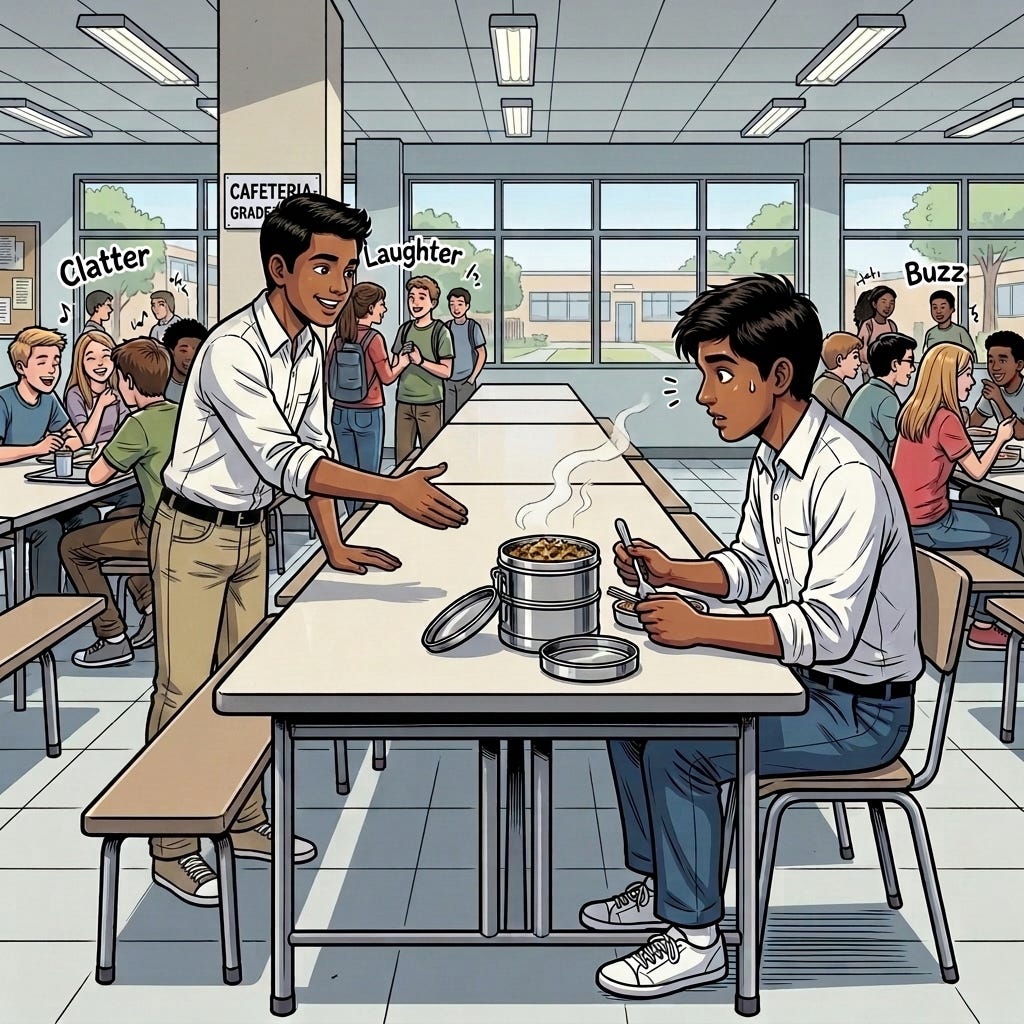
“I am Kamal,” the boy introduces himself. “The Sambar smells good. Did your mother make it for you?”
“Yes,” Arnav replies. “But I think the smell of the spices bothers the people around me.”
“I get it. I’ve been there,” Kamal says. “Come with me.” Arnav picks up his Tiffin and lunch tray and follows the boy across the expansive cafeteria. Finally, in the farthest corner Kamal reaches a table. Sitting there are three other Indian boys. Boys that look just like him.
“Guys, this is Arnav,” he says to the other three.
“Arnav, this is Ashwin, and Deepak.” The boys stand and welcome him, shaking hands.
“I didn’t even see you when I walked in,” Arnav says. “Why are you sitting here in the corner.”
“It’s just easier,” Ashwin says, looking down at his lunch tray.
Arnav notices that all four boys have cafeteria trays, plain pasta, salad, and fries.
“You don’t bring lunch from home?” Arnav asks.
An awkward silence falls over the table.
“I used to,” Ashwin says. “First week here, I brought idli-sambar. Some kids…” He doesn’t finish.
“They made fun of it?” Arnav asks, thinking of his own experience.
“Not exactly. They just… asked a lot of questions. ‘What IS that?’ ‘Does it smell like that on purpose? Eventually I asked my mom to only pack Indian food on the days we can picnic outside. It’s easier that way,” Ashwin explains.
“Same. When I bring my lunch, I only bring PB&J. Like everyone else,” Deepak says.
Kamal holds up his slice of cafeteria pizza. “This stuff tastes like cardboard. But at least nobody stares.”
Arnav starts to ask the boys a question. But since he is with other boys from India, force of habit compels him to speak in Hindi. The boys have a shocked look on their faces and Arnav then catches himself.
“Oh, sorry. English only at school,” Ashwin whispers.
“Why? Arnav asks.
“People stare when we speak Hindi. They think we’re talking about them,” Kamal says.
“But we’re not,” Arnav says with a confused voice.
“It doesn’t matter,” Deepak says. “It makes them uncomfortable. So, we just… don’t.”
“How long have you been here, in the United States?” Arnav Asks.
“About a year, maybe a little longer,” the boys reply.
“We’re here for the same reason that you’re probably here,” Kamal says. “Let me guess, your dad works for Microsoft.”
“Yes. Yours too?” Arnav asks.
“Microsoft, Amazon, Expedia, dot.com startup. That’s why we’re here,” Ashwin says.
“Do you play Cricket?” Arnav asks, hoping he finally found his team.
“I played on my school team in India,” Kamal says. “If you would like to join us, we can get two teams together. Between our parent’s coworkers and their kids, we have a network of Indian boys to call on. We can play some games together.”
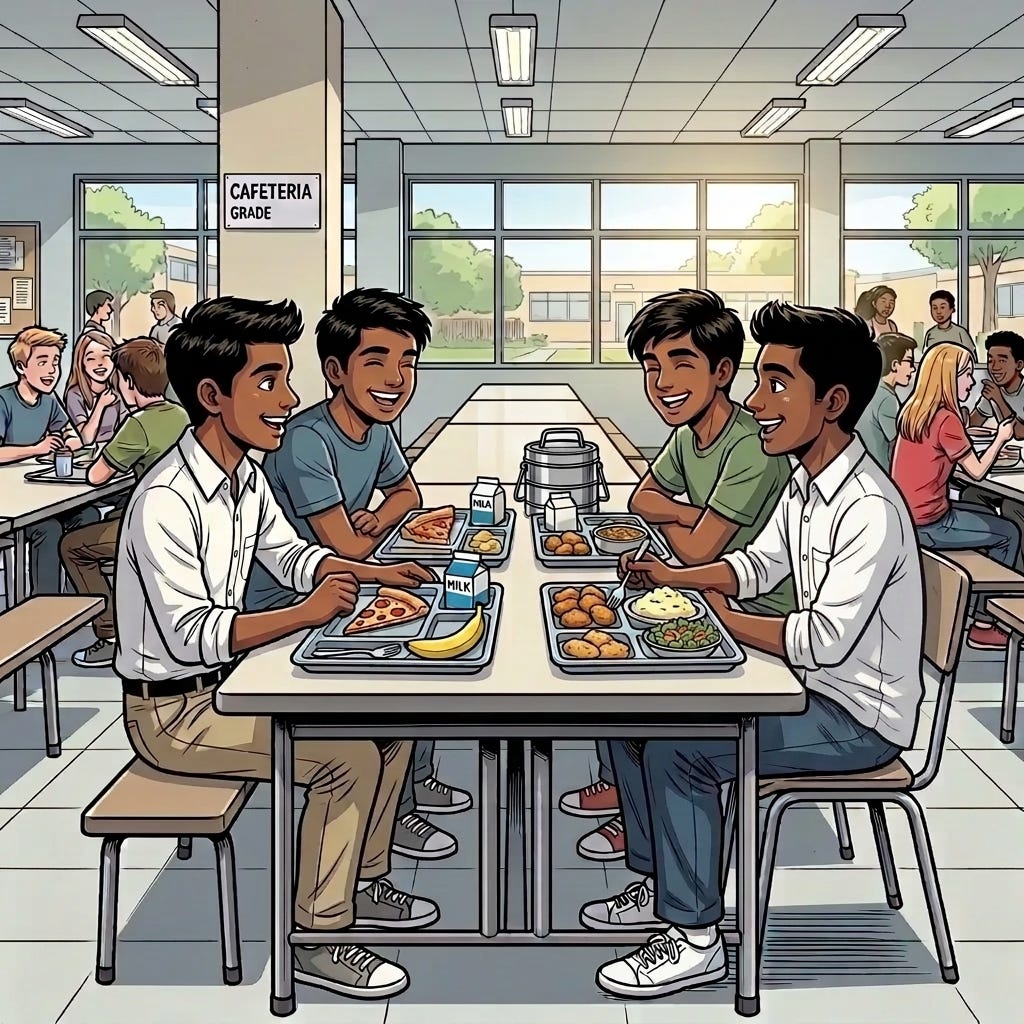
Arnav instantly felt relieved. He thinks he may have found his new team.
You’re Reading: The Road to the Eagle Hunt: Origin Stories from The Great American Eagle Hunt. Arnav didn’t know it yet, but the team he was looking for was already being built.
While he was finding his footing in Seattle, other kids across the country were going through their own defining moments. Each of them would eventually find their way to the same troop, the same challenge, and the same impossible mission.
This is a five-part origin story series. Each installment stands alone, but together they tell you everything you need to know about the young man part of The Great American Eagle Hunt, before the adventure even begins.
Arnav Patel | Seattle, WA | 1998–1999
- Part 1 — The Last Game He Would Ever Play for India
- Part 2 — Nobody Told Him That Fitting In Would Cost Him Everything
- Part 3 — The Bald Kid on the Sticker-Covered Bike Changed Everything
- Part 4 — They Gave Him Bad Rope, a Torn Tarp, and Rigged the Game. He Won Anyway.
- Part 5 — One by One, His Friends Quit. Then He Did Too.
More origin stories are here. Over the coming weeks and months, meet the other young men whose paths are about to collide, each one carrying a story that shaped who they became when it mattered most.
The Great American Eagle Hunt, the novel these characters call home, is available soon.
If this story moved you, share it with someone who may enjoy it. Forward this post. Send the link. Tag a Scout, a parent, a teacher, or anyone who still believes the right story finds you at the right time.— Joe Paul, Author